
Ils Dorment
Ils Dorment
Thematic Background
Diederik came across a collection of wartime diary fragments written by young Dutch women and girls. Their backgrounds varied greatly—from young women raised in NSB families to Jewish teenage girls in hiding. The fragments were arranged by date rather than by author:
“Seeing the war unfold chronologically through so many profoundly different perspectives makes World War II infinitely more tangible than statistics and facts can.”
What stood out most was the humanity of everyday life, in which we recognize ourselves—falling in love for the first time, missing friends, dealing with annoying classmates—set against the backdrop of war. For many women, life simply went on, albeit overshadowed by a looming threat.
Musical Structure
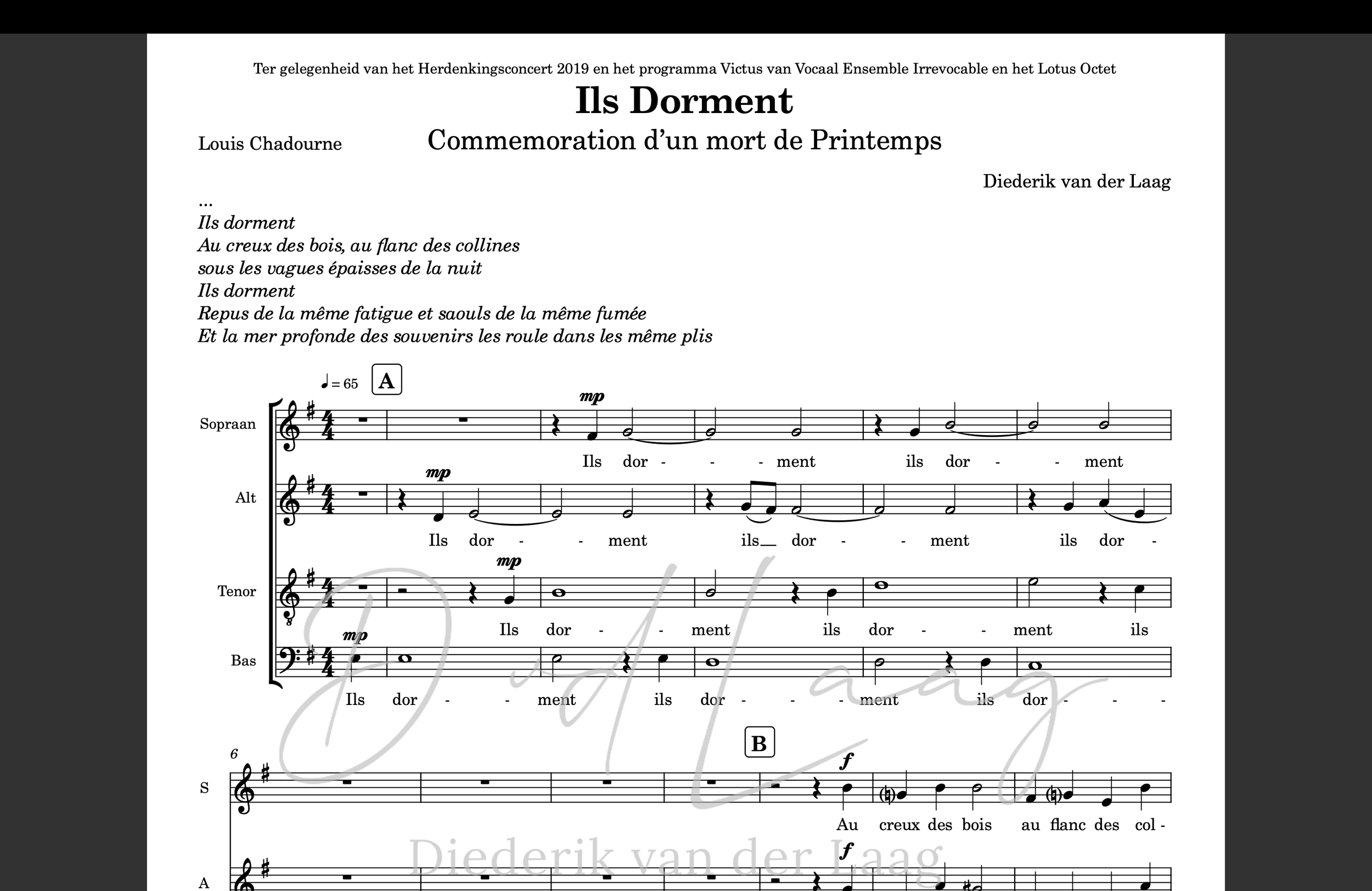
Ils dorment is written for solo quartet and choir. The solo quartet represents a family (father, mother, daughter, and son). The choir symbolizes the surrounding community, bearing witness and sharing in their experience. Someone close to the family has been taken from them—suddenly and irrevocably. Yet, even in mourning, it becomes clear that this person continues to live on in la mer profonde des souvenirs, “the deep sea of memories.”
Text – Veteran & War Poet
The text of Ils dorment is by Louis Chadourne, a French writer from an artistic family. In 1915, he was wounded at the front and received a high military honor. His first novel appeared in 1919, and after touring the Caribbean and South America as a businessman’s secretary, he published the book that made him famous (and still remembered): L’inquiète Adolescence (“The Restless Coming of Age”). This autobiographical novel tells the story of a boy at a religious boarding school, rebelling against the strict norms of the time. He exchanges spiritual longing for sensual desire.
In mid-1921, Chadourne was hospitalized for severe depression and died in the spring of 1925 in a hospital near Paris.
Ils dorment is a fragment from his wartime diary notes, published in Commémoration d’un mort de printemps.
Ils dorment (1917)
French original:
Ils dorment
Au creux des bois, au flanc des collines
sous les vagues épaisses de la nuitIls dorment
Repus de la même fatigue et saouls de la même fumée
Et la mer profonde des souvenirs les
roule dans les même plis.
English Translation
They sleep
They sleep
deep in the woods, along the slopes of the hills
beneath the heavy waves of night
They sleep
sated with the same weariness, and drunk with the same smoke
And the deep sea of memory
folds them into her same embrace.
Alternative Translation by Diederik
They sleep
In the forest, along the hills
under the heavy waves of night
They sleep
Resting in the same fatigue and intoxicated by the same smoke
And the deep sea of memories carries them
into the same form.
Ils Dorment
Thematic Background
Diederik came across a collection of wartime diary fragments written by young Dutch women and girls. Their backgrounds varied greatly—from young women raised in NSB families to Jewish teenage girls in hiding. The fragments were arranged by date rather than by author:
“Seeing the war unfold chronologically through so many profoundly different perspectives makes World War II infinitely more tangible than statistics and facts can.”
What stood out most was the humanity of everyday life, in which we recognize ourselves—falling in love for the first time, missing friends, dealing with annoying classmates—set against the backdrop of war. For many women, life simply went on, albeit overshadowed by a looming threat.
Musical Structure
Ils dorment is written for solo quartet and choir. The solo quartet represents a family (father, mother, daughter, and son). The choir symbolizes the surrounding community, bearing witness and sharing in their experience. Someone close to the family has been taken from them—suddenly and irrevocably. Yet, even in mourning, it becomes clear that this person continues to live on in la mer profonde des souvenirs, “the deep sea of memories.”
Text – Veteran & War Poet
The text of Ils dorment is by Louis Chadourne, a French writer from an artistic family. In 1915, he was wounded at the front and received a high military honor. His first novel appeared in 1919, and after touring the Caribbean and South America as a businessman’s secretary, he published the book that made him famous (and still remembered): L’inquiète Adolescence (“The Restless Coming of Age”). This autobiographical novel tells the story of a boy at a religious boarding school, rebelling against the strict norms of the time. He exchanges spiritual longing for sensual desire.
In mid-1921, Chadourne was hospitalized for severe depression and died in the spring of 1925 in a hospital near Paris.
Ils dorment is a fragment from his wartime diary notes, published in Commémoration d’un mort de printemps.
Ils dorment (1917)
French original:
Ils dorment
Au creux des bois, au flanc des collines
sous les vagues épaisses de la nuitIls dorment
Repus de la même fatigue et saouls de la même fumée
Et la mer profonde des souvenirs les
roule dans les même plis.
English Translation
They sleep
They sleep
deep in the woods, along the slopes of the hills
beneath the heavy waves of night
They sleep
sated with the same weariness, and drunk with the same smoke
And the deep sea of memory
folds them into her same embrace.
Alternative Translation by Diederik
They sleep
In the forest, along the hills
under the heavy waves of night
They sleep
Resting in the same fatigue and intoxicated by the same smoke
And the deep sea of memories carries them
into the same form.